Monday, December 7, 2009


Saturday, December 5, 2009
Social Class and Culture
Class, as in social rank, is a truly self-defeating concept. Do you think "class" really exists in reality as it is talked about? How much of it is delusional? There is definitely inequality in terms of money, material possessions, and access to services and opportunities. But how much of that really determines the way people live? It's more the imaginary associations and feelings of entitlement or non-entitlement that are at the basis of action and thought. Advantages and disadvantages exist purely in the subjective realm; it is all but impossible to analyze what truly gives someone an edge. In a way, wealth and poverty are both curses. But within those curses also exist, like blades of grass in a rock-field, virtues. They need to be cultivated, though, those virtues. They will not grown on their own. Hence, culture. One can blame everything on class, as one can blame everything on race, gender, nationality. But what really matters is one's own ability to recognize the budding sprouts on the terrain on which one happens to find oneself (any terrain is a rough terrain, if you are on it). That's culture. Culture is not about family pedigree or socioeconopolitimetridevelopedevelopinginnercityrannical status. Similarly, class inequality is not about the average per capita income and the high school drop-out rate. It has to do instead with a displacement and misdirection of various discontentments and feeling of self-aggrandizement or diminution all across the board. It's all very phantasmagoric and symbolic. Mushy and shifty stuff, like light and sounds (art, music, that kind of thing). If only we were able to respect others in all walks of life (one person can be walking more than one walk at a time), and talk to each other in a straightforward way. Oh, superiority/inferiority complex! Oh, frankness! Oh, culture! By the way, there is no high or low culture. Do a somersault, and you'll see why.
Friday, December 4, 2009
Keeping Track
German, Chinese.
DDDRussian, Korean.
DDDDDDPersian, Arabic.
DDDDDDDDDSwedish, Vietnamese.
Latin.
DDDSpanish, Portuguese.
Snails
You know that toilet bowls really are shells,
You also carry your mind in a shell, too. The skull, yes?
And so are bath tubs, wash basins, and yes, even plates.
Cups, too, and pitchers,
Glassware and silverware,
You also carry your mind in a shell, too. The skull, yes?
The shell, the shells, the shelling shelly-shell.
The wondrous magic of the spiral, this holiday season: Cheers!
Slow Thinking
Slow thinking is my life;
That's how I would like to live.
Slow thought,
The beauty you notice,
Less glare.
Cannot catch up,
But can catch.
Can slip,
But cannot slip away.
(Can slip, because of the slow, slow, slowness.)
Moving, but slowly: a snail.
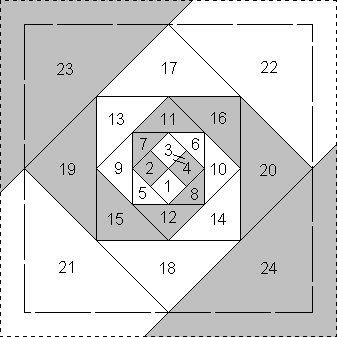
Instead of something quicker, much too quick actually, as in, say:
123456789101112131415161718192021222324
Because you might get:
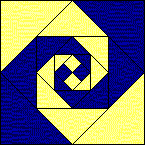
(Images courtesy of "3'' Mini-Block Swap Archive," alanandmike.com)
Monday, November 30, 2009
Throwers
Mini said: "Name throwers, watch out! The trucks are coming to pick you up. Oh, name throwers, those who throw around buzzwords and empty terms to mask their deficiency in thought and thoughtfulness, don't they realize that along with the names that they throw, they are throwing themselves out?"
Mini-Dua said: "Oh, name throwers. The trucks, thinking that you were also trash, will recycle you and your names. Do you want to let something like that fall upon you? No! So please, stop throwing those names around. They deserve better treatment, too, the names. Put them in the recycle bin, nicely and softly."
Mini-Tiga said: "But you know what, the trucks are never going to come. They drifted away with the trash."
And people thought the trash was gold; I guess the trucks did, too...oh, Mr. Voltaire!
Friday, November 27, 2009
The Birds
The birds
Did I realize
That their eras and our eras do not match
For them, 9/11 has never happened
To them, the landing of man on the moon is unknown
Unless there is a bird network of news, reporting on humans
But even then
Their songs do not completely belong to our sense of time
Of place
Their visions take us to another cosmos, which has always existed
But to us, has remained foreign and invisible
The birds
They include all the singers and writers from the past
But also real birds
Singing now in the sky
Wednesday, November 25, 2009
Monday, November 23, 2009
Role Models
Perhaps I have said this earlier already, but I do not believe in "role models." That is, I do not believe anyone could really benefit from getting know people to whom one may strive, one day, to come close. Nor do I believe in the power of the will to emulate. This world is already so full of models, packages, and standards. They mislead more than they instruct.
But I suppose, but I guess - role models can do good, if you realize that your role models, whomever they may be, live inside you, not outside. They are the emanations of your dreams and anti-dreams, rather than the real people whom they really are. The same goes for "negative" role models, the people whom you wish you would never become. They, too, live in you.
I dislike adulation. Emulation, I view with suspicion. The real role models are never people, you see. They are always ideas and colors; sounds and music; postures and speech. Think about the commercial fashion "models." We rarely care about who they are in real life; we only care about the way they walk, and not even the way they look, to us.
Don't let personalities be your role models; look to their choreography, instead.
Japano-Serbian Poet
Just a quick introduction; there is a Japanese poet who writes poetry in both Serbian and Japanese. Her name is Kayoko Yamasaki. She has lived in Serbia since the 1980s, and is currently a professor of literature at the University of Belgrade. For her doctorate, she studied avant-garde Serbian and Japanese poetry within a comparative framework. She will be speaking on November 29, 2009 in Tachikawa, Tokyo, on the relationship between narrative perspective and avant-garde poetic movements. She chose to remain in Belgrade when the NATO bombed the city in 1999.

The image below shows Kayoko Yamasaki posing for the camera. I like the skirt in black. It reflects light, like a darkened, unshaded window.
(Photo courtesy of Kulturni Centar Beograda)
Sunday, November 22, 2009
Not to Be Taken Lightly
Someone, please, we need to translate Shinichiro Nakamura's works into English. He is too great to remain unknown outside of Japan, although he is also not terribly well known there. And his greatness is not immediately apprehensible. That fact adds to his greatness, as corny as that may sound, and does set him apart from the likes of, I must say, Mishima, Murakami, Tanizaki, etc.
The image below is taken from Nakamura's preparatory notes for his books on Edo kanshibun (early modern Japanese literary and philosophical texts composed in the Chinese style), including The Traffic of Clouds, Sanyo Rai and His Epoch, Horti Poetae (Poet's Garden), and Kenkado Kimura's Salon.

(Photo courtesy of the National Institute of Japanese Literature)
Friday, November 20, 2009
Wednesday, November 18, 2009
Not Far Too Close
RRRRRRRRRRRRIn May 2009, there was a fire in Niamey,
RRRRRRRRRRRRRRRRRRRRRRRRRRRRRRRRRecuerdos y memoria, not
RRRRRRRRRRNiger
RRRRRRIn the city's central market
RRRRRRRRRRRRRRRRRZFire
RRRRRRBlocked streets, vendors and merchandise
RRRRRRRRRescue: extinguish, pillage
In time, too late
RRRRRRRRRRRThe sun spread on the ashes
RRRRRRRRRRRRRBlame the government
RRRRRRRA plot to distract -
RRRRRRRRRRRRRRRRRRRRRRRRRRRRRRRRRecuerdos y memoria, not
RRRRRRRRRRRRRRRRRRRRRRRRRRRRrfar too close, of the fires in Yedo
Tuesday, November 17, 2009
Violets
There is a terrible glimmer in the sky
Look to your left, at the violets
They will survive this, the ordeal
* * *
Sunday, November 15, 2009
Profiles
Facebook, Mixi, and the like.
Profiles proliferate; stupid profiles.
Some people are misled to think that each one of us ought to be expressed in pre-packaged meatbags with labels, as if we were flat, very flat characters in a cartoon.
"Impressive," some say, marveling at other people's profiles. Their simplemindedness is impressive. Actually, appalling. Sad, in fact.
One learns non-linear equations at, what, age twelve? Only if non-linear narratology were taught right around the same time. Then we would begin to see, very clearly, that those profiles are the most disastrously fake pieces of shit.
Don't excuse the unclean language.
Friday, November 13, 2009
Nocturne
Deep in the night: according to my dictionary, "a useful" (noun) in Australian slang means "a person who runs errands or handles unimportant tasks."
Megra screamed: "Utilitarians, beware!"
"Because," Zadie added, "Useful shan't mean important."
Relevance is closer in meaning to importance than to usefulness. Sands trickled down a palm tree at night. Quack-quack, the quacker quacked. Then the day broke.
Painting
Literature and the arts make some people feel unbearably uneasy.
Those people begin to question their own lives: Have I always lived in deep reflection? Have I always striven to learn and develop my taste for the high arts? Have I thought about my place in this world, and what to do about it?
No, they say. No, they shake their heads. They have been to busy trying to feed themselves and their families. They have toiled for so long to secure their social standing, keep a roof over their heads, and make sure they have insurance and the benefits. They have been too busy.
Then some of them, although not all, begin accusing the literati of idling their time, like good, well-endowed dilettantes. When we have been working so hard. But on what?
It's true some members of the literati are indeed idle, or boring, or both. But the accusers also paint an unnecessarily bleak picture of the world, making it seem as if it were human destiny to have no time and money to spare for colors, music, and words - for reflection. If one believes in this picture, then the world becomes just that.
But remember, it is just a picture. It can be torn down or repainted. (Or exalted.) I wish the number of men and women running for-profit businesses who also appreciate thoughtfulness and good taste will increase. They are the potential champions, much more than benefactors on the periphery.
The greatest fallacy in business is to equate time with money and understanding that equation as a motive for cutting back on time. No; just as money ought to be enjoyed, time also ought to be enjoyed. If one cut back on it, there would be nothing left.
Also, please don't "invest." The expectation of a return is stifling and, quite simply, stressful. Seriously, it is okay if the "returns" never come. Take it easy, please, for everyone's sake.
Yes? Children are starving in Africa? Don't throw around Africa too much like a ball; Africa is the place of culture. Look, there is a starving man under the bridge, right under your foot in Metropolitan Europe, or Japan, South Korea, or whatever place where people are not supposed to be starving. Yes, money is not easy to share. Then, what about time? Share your time, in whatever way - there are more than billion possible channels - so the person the most distant from you, or the most proximate to you, can step forward with a renewed sense of hope and optimism.
Start by painting a picture.
Thirst
Tanha, thirst.
I search for thirst, even as I constantly look for a sense of fulfillment.
I search for thirst, even as I constantly look for a sense of fulfillment.
Dukkha, suffering.
I search for suffering, too, but that phase in my life is over, at least for the time being. But then, regardless of what you want, suffering hits, sometimes without warning, or, really, with or without warning. You are powerless as to the timing and the manner of its hitting.
I do not believe thirst necessarily leads to suffering. I don't want to believe. I refuse to believe. Suffering is something that hits all of a sudden, and it's a completely impersonal thing. Like an accident. Thirst has nothing to do with it.
Thirst, it can be painful or enjoyable depending on your belief. If you believe thirst is painful, it will be painful. If not, not.
Suffering is always painful, whatever your belief.
But thirst, it will give life, if you believe it will. If not, it only takes your life away.
Wednesday, November 11, 2009
Central Asia
I went to Central Asia in my dream. I was still on the Chinese side of the border, but from the roof of the rolling bus on which I lay, flat on my stomach, I saw a sign post that read: To Kyrgyzstan. All around, there were bare, brown hills and unbelievably steep roads. My spirit soared. Then the airport, with a rectangular indoor pond.
So many languages: Sogdian, Dungan, Chagatai. Endless dreams.
Tuesday, November 10, 2009
Clutter
He loves his clutter, even when he hates it.
It is him; his clutter. In the words of a self-help expert, "it expresses you." Not: "who you are," because, who "are" you really?
No one really knows. But "you," it includes all the were's, were not's, are, are not's, not to mention the have been's and had not been's, your worlds and others'.
That clutter, helping me stay afloat, or sink, depending on the circumstances, and the time of day, keeps my desk cluttered. I'd like to clean it up now, though, so that my desk can get cluttered anew. Again.
Monday, November 9, 2009
A Feast for the Eyes
韈跫燕瑤
詭嶷苡咒
呱咎響忱
鴽然傚孝
A rather threatening feast. It has legs, perhaps dinosaur legs, footsteps, swallows, along with socks that hide one's feet, white pearls, leather, black magic, parental love, gourd-in-mouth, reverberations, some kind of bird, burning dog meat, truth, stumbling feet, intellectual or mental imperturbability, barley grain or lotus seed, lies or difference, and at last, young and old.
Sunday, November 8, 2009
Prayer-Question
Master of masterminds,
Or a leaf fell on the water: Flap. Current. Turn. Rice cooker, armadillo!
Please provide for the needy,
But when you provide for the needy,
How do you know what the needy really needs?
How to avoid being presumptuous,
How to make the needy truly happy?
You would say it was love; that must be true.
But how to make it true?
How, in your name, how?
The organ blared out the answer: Blare blare, blare!!!
Or the bell sounded: Gong gong, gong!
Or a leaf fell on the water: Flap. Current. Turn. Rice cooker, armadillo!
I think you should go to sleep.
Saturday, November 7, 2009
批評練習1
Moutros wrote the following text holed up inside a small cave shaped like one half of a melon. To me, the text was completely illegible except for the Arabic numeral, 1.
Let's read, man!
To read, we need time.
Let's ask for time.
Hello, time.
Goodbye, time.
Time has a life, too.
Let it do its thing, please.
Leave it alone, for Godot's sake....
1. 時間的・空間的に異なる「他の文化」を理解する可能性について。 (On the possibility of inter-cultural understanding, modern science, and medieval Christianity.)
他文化を理解しようとするとき、まず自分の時代と文化、言わば自意識を省みる必要があるが、それだけでなく、その自意識の中に多様性や驚きを見い出す過程をも必要とする。自らの時代や文化の内にも、単一的、あるいは固定的な枠組みの中に収まり切らない価値観や慣行が存在し、その文化や時代の内部で有効な役割を担っているのではないか、と常に自問し疑いながら、他者に目を向けてみる。そうすれば、自意識に基づく尺度が、必ずしも絶対的な真実のみの上に成立しているとは限らないことに気付く。つまり、明確に「他」の文字とレッテルを貼りつけることのできる相手と直接的な関わり合いを持つ以前から、自己の内側に潜む他者的存在について熟考し、あくまでも自己の中の他者という矛盾を孕んだ自画像の前で、目を養う。それから本番、他者の前へいよいよ進む訳だが、自己の内側でより本質的に感じられる部分、そして同じく自己の内側でより異質的に感じられる部分の両極にそれぞれ対応する側面を、縦横に他者の内側に認めることができたならば、他の文化や時代を理解し始めようとすることができる。何よりも、分裂した、あるいは多義的な自己の姿に、他者の姿の、細部は大きく異なるかも知れないが、それでも、同じく分裂し多義的、多面的な性質の予感を識別することが、重要ではないだろうか。それぞれの文化・時代・空間に固有であるものは大切に扱うが、同一の文化・時代・空間に存在するからと言って、固有種同士が矛盾や不調和を作り出すことはないはずだ、と断定するのは、他者の理解のみならず自己の理解の幅をも狭めてしまうことになろう。
例えば、近代科学を自分の文化と位置付け、他文化であるヨーロッパの中世文化の理解を目指そうとしよう。近代科学の担い手として最初に挙げられるのは、科学者たちであろうが、実際は、科学者ほどは専門知識を持たないにも関わらず、科学の確実性を多少とも信じる多くの一般人によっても支えられている。一般人の中で、地動説を正論として信じており、日々の暮らしの中でもその現象を五感により捉えられていると信じていたとしても、科学的な方法で、地動説の一部始終を説明・証明できる者は果たして何名いるであろうか。これらの一般人、言わば「素人」は、数にすれば人口の大多数を占めるのであろうが、少なからず盲目に近い信頼を科学に置いている、という観点から判断すれば、その非専門性のゆえに、近代科学の内側にいる他者、と名付けることができないだろうか。この近代科学における専門家対素人の構造を中世ヨーロッパに大まかではあるが置き換えるとすれば、キリスト教における聖職者及び政治的権力者、対、一般人あるいは「俗人」・「俗衆」の構造が浮かび上がるのではないか。創造主の信仰については、聖職・権力者であっても、一般人であっても、本物の顕現、エピファニーのような宗教体験のある者も、無い者も、ばらばらに分散して存在していたかも知れないが、当時のキリスト教文化をなるべく包括的に捉えるとすれば、聖職・権力者側が、比較的、専門的知識に疎い俗衆に信仰を勧め、広め、その対価として宗教の支持を求めた、という点では、近代科学の科学者と素人による構造に類似している。従って、もし中世文化は無知蒙昧だと決めつける者がいれば、それは決して創造主やキリストの信仰のみが無知を助長したとは言えず、社会全体に無知が氾濫したと主張するのであれば、専門家と非専門化の間の非対称な権力構造や知識の分配に拠るところが大きいと考えてはどうだろうか。そして、この非対称な構造は、近代科学においても観察することができ、例え、近代科学が迷信の類を大幅に取り払ったとしても、大衆による科学の支持には「非専門性」の名を被った「無知」が一役買っている、と考えることもできるのだ。また、更に付け加えるとすれば、近代科学の専門分野内においても、まだまだ無知の領域は広く、皮肉なことに、科学の専門知識が深ければ深い者ほど、人類の永続的な無知を思い知る毎日を送るものではないか、と推測する。
Ignorance ought to be used as wrapping paper.Let's read, man!
To read, we need time.
Let's ask for time.
Hello, time.
Goodbye, time.
Time has a life, too.
Let it do its thing, please.
Leave it alone, for Godot's sake....
Subscribe to:
Posts (Atom)